The first question almost everybody asks me is, “What’s your price per square foot?”
I get why. You want one number you can hold onto and compare. But for a custom home, that number is a trap — and if a builder hands you a confident one over the phone, be careful.
Here’s the honest version.
Square-foot pricing has a use — just not the one you think
I actually use square-foot pricing myself for early, ballpark, preliminary numbers. It’ll get you somewhat in the range — enough to know if we’re in the same ballpark before we spend real time on it. That’s a fair use.
What it can’t do is tell you what your home will cost. Everything that goes into the price of a custom home is unique to that home — the site, the difficulty of the construction, the number of trades involved, and the materials you pick. Two homes with the exact same square footage can be a hundred grand apart because one sits on a flat, easy lot and the other’s cut into a slope with a long driveway and a hard foundation. Square footage doesn’t see any of that.
A simple picture that shows why
I picked this up in a builders’ association class in Austin, and it stuck with me. The instructor drew a plain floor plan — just four walls, stone on the outside, a 10-by-10 room. A hundred square feet. Then he asked: what costs more to build, the empty space in the middle, or the exterior walls? Everybody agrees it’s the walls — that’s where the stone is, another trade, more material.
A 10-by-10 room has 40 linear feet of that expensive exterior wall.
Then he drew a different hundred-square-foot room — same floor space, but stretched long and skinny, say 2 feet wide and 50 feet long. Still a hundred square feet. But now you’ve got over 100 linear feet of exterior wall — more than two and a half times the stone, the trades, the material. Same “square footage.” Completely different cost.
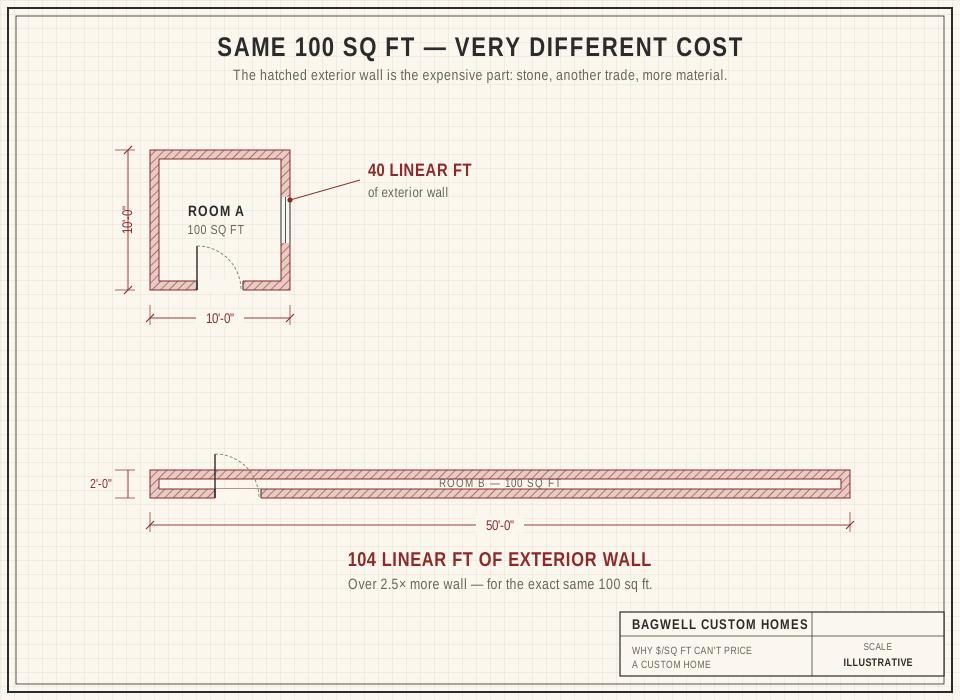 Same 100 square feet, two very different amounts of exterior wall — the expensive part.
That’s the whole thing in one picture. The design itself changes where the money goes. Square footage can’t see the shape of your house, and the shape is a big part of the price.
The real 2026 ranges around here
I’ll give you an honest number instead of dodging it. Right now, midway through 2026 in the Leander area, custom square-foot pricing is running in the upper $200s and ranges up to around $400.
The $400 end is the higher end — those are very different projects, with finishes and site work to match. Most builds land lower. But that spread, from the upper $200s to $400, tells you everything about why one number can’t price your house. Where you land inside that range depends on your lot, your finishes, and what the build actually takes.
What’s pushing prices right now
The biggest thing I’m seeing is materials — construction materials across the board, and roofing especially. Metal and asphalt both. Regular composition shingles have gone up quite a bit, and they just keep climbing. It’s a little outrageous right now, honestly.
How I protect a client from prices moving mid-build
The best defense against materials climbing on you is to buy early.
We did exactly this at Community First Village — that’s Mobile Loaves and Fishes up in North Austin. We built all the bathrooms and kitchens for the community in phase two, and that job had a lot of standing-seam metal roofing. This was right around COVID, when supply channels were a mess and labor was hard to come by. So we bought a big roll of the raw roofing material up front and held onto it. By the time we got to the roofing, the price moves didn’t touch us — the material was already paid for at the old number. That worked out real well for the client.
That’s the kind of thing you’re paying a real builder to think about ahead of time, not scramble on later.
Where you should never cut corners
If you want to know where people actually waste money — or leave value on the table — it’s usually by skipping the design and the architect.
A home that’s designed well and placed right on the lot has value from that alone, before you spend a dime on fancy finishes. If you’re just honest with your finishes — meaning you don’t try to make something look like what it isn’t, you just put in what you can genuinely afford — the design itself is what makes the home stand out. It’ll feel unique, and it’ll have a natural flow that fits your life.
That’s the part I’d never tell you to cheap out on. It’s fine, and honestly smart, to gather plans you like online and say “I want this part and that part” — that speeds things up. Pull in the features you loved from every place you’ve ever lived, too. But the design, the layout, and how the home integrates with your life and your lot — those are the priceless parts. Get those right and the rest follows.
So when someone asks me for a price per square foot, I don’t dodge it — I just tell them the truth. The honest number comes from your lot and your plans, not from a phone-call guess. If you’re ready to talk real numbers, let’s walk your project together.